How to Set Up a Portable Air Conditioner Properly

Set up a portable air conditioner by sealing the window kit tightly, keeping the exhaust hose short and straight, and plugging the unit directly into a safe wall outlet. In San Fernando Valley homes, the right placement and airflow matter just as much as the unit itself.
Setting up a portable air conditioner the right way can make a big difference in San Fernando Valley homes, where late-afternoon heat, dry air, and sun-baked windows can turn one room into the hottest spot in the house. A good setup helps the unit cool faster, run more efficiently, and avoid the common frustrations that make people think portable ACs “don’t work.”
If you’re renting an apartment in Van Nuys, cooling an ADU in North Hollywood, or trying to make a bedroom more bearable in Panorama City, the details matter. The right window seal, hose routing, and placement can be just as important as the AC itself, which is why it helps to understand how a portable air conditioner works before you plug one in.
- Seal first: Tight window sealing prevents hot air from leaking back in.
- Keep it short: A shorter exhaust hose usually cools better.
- Use safely: Plug into a wall outlet, not a weak extension cord.
- Match the room: Size and layout affect cooling performance.
- Plan for SFV heat: Start early before rooms bake in afternoon sun.
Why Portable AC Setup Matters in San Fernando Valley Homes
Portable ACs are popular in the SFV because they’re flexible, renter-friendly, and easier to move than a window unit. But the Valley’s mix of hot afternoons, dry conditions, and homes with older windows can expose weak setup choices fast.
Heat, dry air, and late-day cooling needs in SFV
In many San Fernando Valley neighborhoods, the biggest cooling challenge is not all-day humidity—it’s the strong afternoon heat that lingers into the evening. That means a portable AC often needs to work hardest right when families are home, cooking, studying, or trying to sleep.
Dry air can also make a room feel cooler than it really is, which sometimes causes people to under-size the unit or place it in the wrong spot. If the exhaust hose leaks hot air back inside or the window kit is loose, the AC ends up fighting the room instead of cooling it.
Common setup mistakes that waste energy or reduce comfort
Some of the most common mistakes are simple: a hose that’s too long, a window kit with gaps, or a unit placed too far from the window. These issues force the AC to run longer and can make the room feel only partly cooled.
Another big one is ignoring airflow. Portable ACs need room around them, and if vents are blocked by furniture, curtains, or a corner wall, performance drops quickly. In Valley homes, where every degree matters during a heat wave, that can be the difference between tolerable and miserable.
What to Check Before You Start the Installation
Before you unpack anything, take a few minutes to match the unit to the room and the window. That small prep step can save a lot of frustration later, especially in apartments, condos, and converted spaces where layouts vary a lot.
Room size, window type, and outlet access in apartments, condos, and ADUs
Start with the room size. A portable AC that’s too small will struggle in a sun-facing bedroom or open living area, while an oversized unit may cycle awkwardly and waste energy. In the SFV, rooms with big west-facing windows often need a little extra cooling help.
Next, check the window type. Sliding windows and double-hung windows usually work best with standard portable AC kits, but older frames, security screens, or unusual openings may need extra sealing material. Also confirm that the nearest outlet is close enough that you won’t be tempted to use a risky extension cord.
Portable AC specs that matter: BTU, hose length, and drainage style
BTU rating matters, but so does real-world use. A higher BTU unit may sound better on paper, yet if the hose is awkward or the room is poorly sealed, you won’t get the comfort you expected. For SFV buyers, it’s often smarter to match the unit to the room and the window setup first.
Hose length matters too. Shorter is usually better because long, twisty hoses trap heat and reduce efficiency. Drainage style also matters: some units self-evaporate most moisture, while others need regular draining, especially if you’re using dehumidifier mode.
- Room square footage and sun exposure
- Window style and sealing options
- Nearby outlet location
- Hose length and routing path
- Drainage method and maintenance needs
Choosing the right spot near bedrooms, garages, patios, or family spaces
The best spot is usually near a window, close to an outlet, and out of the main traffic path. Bedrooms are the easiest use case, but family rooms, home offices, and garage-adjacent spaces can also benefit if the unit is placed carefully.
If you’re cooling a patio hangout space or a converted garage, remember that heat enters from more than one direction. Walls, doors, and unsealed openings can make the AC work much harder, so placement and sealing become even more important.
How to Set Up a Portable Air Conditioner Properly Step by Step
The actual setup is usually straightforward, but it pays to go slowly. A careful installation usually cools better, sounds quieter, and lasts longer than a rushed one.
Unboxing, positioning, and assembling the exhaust hose
First, unbox the AC and check that all parts are included: hose, window kit, adapters, drain accessories, and remote if provided. Set the unit upright on a flat surface and let it sit if the manufacturer recommends it after transport.
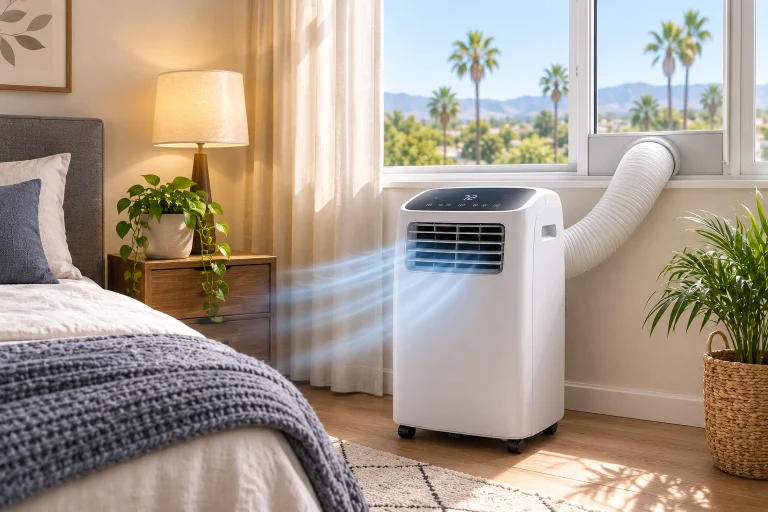
Position the AC near the window where the exhaust will go, but leave enough space around the intake and output vents. Then assemble the exhaust hose according to the manual, making sure the connections are snug and the hose is not kinked or stretched tight.
Do not place the hose through a cracked window without sealing it. Hot outdoor air, dust, and even smoke can leak back inside, which defeats the whole point of using the AC.
Installing the window kit securely for sliding and double-hung windows
Window sealing is where a lot of portable AC setups succeed or fail. For sliding windows, fit the panel into the open section and lock it in place as tightly as possible. For double-hung windows, lower the sash onto the kit and secure it so the opening is covered without gaps.
Use the foam or sealing strips that come with the unit, and add extra weatherstripping if needed. The goal is not just to keep the hose in place—it’s to stop hot air from sneaking back in around the edges.
If your window frame is old, uneven, or partially damaged, you may need extra sealing materials to get a proper fit. That’s common in older Valley rentals and can make a big difference in cooling performance.
Connecting the drain line and handling condensation in dry SFV weather
Even in dry weather, portable ACs can create condensation, especially if you run them for long periods or use dehumidifier mode. Some models evaporate most moisture automatically, but many still need a drain hose or periodic emptying.
Connect the drain line if your unit requires one, and place the end where water can drain safely. If the AC has a collection tank, check it regularly during hotter stretches so you don’t get a surprise shutdown.
Powering on safely without overloading older home circuits
Before turning the unit on, plug it directly into a wall outlet whenever possible. Portable ACs draw a decent amount of power, and older homes in the Valley may already have other appliances on the same circuit.
Avoid sharing the outlet with high-draw items like space heaters, microwaves, or hair tools. If the breaker trips or the plug feels warm, stop and reassess the circuit load rather than forcing it.
Portable ACs usually perform best when the exhaust hose is as short and straight as possible. Every extra bend can make the unit work harder, which is especially noticeable during a hot Valley evening.
Best Placement Tips for SFV Living Spaces
Where you place the unit affects both comfort and noise. In the San Fernando Valley, the right placement often depends on how the room is used during the hottest part of the day.
Cooling bedrooms for hot nights in Panorama City, Van Nuys, and North Hollywood
For bedrooms, place the portable AC where air can circulate toward the bed without blowing directly on you all night. That usually means a corner near the window, with enough clearance for the intake and exhaust.
If the room gets strong afternoon sun, close blinds early and let the AC start before the room fully heats up. That’s often more effective than waiting until bedtime and trying to cool down a room that has already stored heat all day.
Using portable AC in living rooms, home offices, and open kitchen layouts
Open layouts are tougher because cool air spreads out. In a living room or home office, try to contain the cooled zone with doors, curtains, or partial room dividers if possible.
Kitchen-adjacent spaces can be tricky because ovens, dishwashers, and cooking heat add a lot of load. A portable AC can still help, but it will work best when it’s supplementing—not replacing—basic heat control like venting, shading, and avoiding long cooking sessions at peak heat.
For SFV renters or anyone with limited window access, a portable AC with a well-designed sliding-window kit and easy-drain option is usually the most practical setup. It’s not the flashiest choice, but it tends to be the least frustrating in older apartments and ADUs.
Keeping units stable near family traffic, pets, and kids
Portable ACs should sit on a flat, stable floor where they won’t get bumped by kids, pets, or foot traffic. If the unit wobbles, it can get louder, vibrate more, and create wear over time.
Keep cords tucked away and avoid placing the AC where it could block a hallway or create a tripping hazard. That matters in busy family homes where people are constantly moving between rooms, especially during school nights and summer routines.
Portable AC Features Worth Comparing Before You Buy
If you’re still shopping, a little comparison can save you from buying the wrong type for your room. Budget, mid-range, and premium models all have a place, but the best choice depends on the space and how often you’ll use it.
Single-hose vs. dual-hose models for faster cooling in Valley heat
Single-hose units are often cheaper and easier to find, which makes them attractive for first-time buyers or renters. The trade-off is that they can create more negative pressure in the room, which can pull in warm outside air through gaps.
Dual-hose models usually cool more efficiently because they separate intake and exhaust. They can be a better fit for hotter SFV rooms, especially if you want faster pull-down time in a bedroom or larger living area.
| Option | Best For | Note |
|---|---|---|
| Single-hose | Budget buyers, smaller rooms | Simple setup, but less efficient in extreme heat |
| Dual-hose | Hotter rooms, better efficiency | Often a stronger choice for Valley summers |
Noise levels for sleep, remote work, and apartment living
Noise matters a lot if the unit sits near a bed, desk, or shared wall. Some portable ACs are fine for daytime use but too loud for light sleepers, so check noise claims carefully and think about how sensitive your household is.
For apartment living, quieter operation can be worth paying more for, especially if the unit will run at night. A slightly better cooling setup is less useful if it keeps you awake.
Smart controls, dehumidifier modes, and energy-saving settings
Smart controls can be useful if you want to turn the AC on before you get home or adjust settings from another room. Dehumidifier mode is less critical in the dry Valley than in humid regions, but it can still help in certain weather patterns or enclosed spaces.
Energy-saving settings, sleep modes, and programmable timers are worth comparing because they can reduce waste during long run times. That matters if you plan to use the AC through a heat wave or on a daily basis.
When a higher-end model is worth it for larger SFV rooms
A higher-end model may be worth it if you’re cooling a larger open room, a west-facing space, or a room that gets heavy afternoon sun. Premium units also tend to offer better controls, stronger airflow, and sometimes better noise management.
That said, the best value is not always the most expensive model. If your room is small and well-sealed, a mid-range unit may be the smarter buy.
Common Setup Problems and How to Avoid Them
Most portable AC complaints come from installation issues, not the machine itself. A few small fixes can usually improve performance a lot.
Hot air leaks around the window kit
Hot air leaks are one of the biggest efficiency killers. Even a small gap around the panel can let in enough warm air to make the room feel sticky and undercooled.
Check the top, sides, and bottom of the window kit after installation. If you can feel warm air coming through, add sealing tape or foam until the gap is closed.
Poor airflow from blocked vents or wrong hose routing
Portable ACs need breathing room. If the back of the unit is pressed against a wall, or if the hose bends sharply behind furniture, airflow drops and the unit may feel weak.
- Keep vents open and unobstructed
- Use the shortest practical hose route
- Leave space around the unit for intake air
- Pinching the hose behind furniture
- Covering vents with curtains or boxes
- Running the unit in a cramped corner
Drainage issues, error codes, and humidity buildup indoors
If the unit shuts down with a full-tank warning, the drain system may need attention. Make sure the hose is connected properly, the tank is emptied when needed, and the unit is level so water can move the way it’s supposed to.
If the room feels damp or stuffy, the issue may be poor exhaust sealing or a mode setting that isn’t ideal for the weather. In the Valley, that usually means checking the hose, the window kit, and whether the unit is set to cool instead of dehumidify-only.
Extension cord and outlet safety concerns in older Valley homes
Portable ACs are not the kind of appliance you want to casually run through a cheap extension cord. If the cord is undersized or too long, it can create heat and safety issues.
Use a direct wall outlet whenever possible. If you live in an older SFV home and the outlet setup feels questionable, it’s worth pausing before you run a high-draw appliance on a questionable circuit.
Practical SFV Tips for Better Cooling and Lower Bills
Once the unit is installed, a few everyday habits can make it work better. These small changes often matter just as much as the AC settings.
Pairing portable AC with blackout curtains, fans, and evening ventilation
Blackout curtains help block the sun before it heats up the room. A ceiling fan or box fan can also help move cooled air around, which lets the portable AC do less work.
When outdoor air cools down in the evening, opening windows briefly can help flush out trapped heat—just be careful on smoky days or when outdoor air quality is poor. That balance is especially important in the Valley, where late-day comfort and air quality don’t always line up.
Cooling strategies for garages, ADUs, and backyard hangout spaces
Garages and backyard ADUs often need extra sealing because they heat up fast and may not be insulated like the main house. If you’re using a portable AC there, focus on door gaps, window gaps, and direct sun exposure first.
For backyard hangout spaces, portable ACs work best in semi-enclosed setups rather than open patios. In truly open air, the cool air disperses too quickly to make much of a difference.
Seasonal use during heat waves, wildfire smoke days, and power-saving periods
Portable ACs are especially useful during heat waves when the house never fully cools down. They can also help keep one “safe room” comfortable during smoky periods when you want to keep windows closed.
During power-saving alerts, use timers and moderate settings instead of maxing out the unit all day. That can help you stay comfortable without wasting energy when the grid is under pressure.
If you know a hot stretch is coming, set up the portable AC before the worst of the heat hits. Starting early is usually easier than trying to cool a room after it has already baked all afternoon.
Final Setup Recap for San Fernando Valley Homeowners and Renters
Learning how to set up a portable air conditioner properly is mostly about sealing, airflow, and safe power use. Once those basics are right, the unit has a much better chance of keeping your room comfortable through long Valley afternoons and warm nights.
Quick checklist for a proper installation
Before you call the setup done, make sure the unit is level, the hose is short and unobstructed, the window kit is sealed tightly, and the drain system is ready if needed. Confirm the outlet is safe and the cord is not stretched across a walkway.
How the right setup improves comfort, efficiency, and long-term use
A proper setup helps the AC cool faster, run more efficiently, and avoid unnecessary wear. In San Fernando Valley homes, that often means better sleep, less frustration, and a smarter use of energy during the hottest parts of the year.
- Seal the window kit tightly to stop hot air leaks.
- Keep the hose short, straight, and unobstructed.
- Use a direct wall outlet whenever possible.
- Match the unit to the room size and layout.
Recommended Products
SHOP THIS SETUP
AC Infinity Portable Air Conditioner Window Kit with Foam Seal
This is a smart pick for anyone setting up a portable AC in a San Fernando Valley apartment or home because it helps create a tighter window seal and reduces hot air leaks. The adjustable panels and included sealing materials make installation easier, which can improve cooling performance during long SFV heat spells and help the unit run more efficiently.
Frequently Asked Questions
Yes, most portable air conditioners need to vent hot air outside through a window kit. Without proper venting, the unit will push heat back into the room and cool poorly.
It’s best to avoid extension cords and plug the unit directly into a wall outlet. Portable ACs draw significant power, and the wrong cord can overheat or cause safety problems.
Sliding and double-hung windows usually work best with standard portable AC kits. Other window types may need extra sealing materials or a different setup.
The most common reasons are air leaks, a hose that is too long or bent, blocked vents, or a unit that is too small for the room. Checking the setup usually fixes the problem faster than changing settings.
Some models remove most moisture automatically, while others need regular draining. If your unit has a tank or drain line, check it often during long cooling sessions.
Place it near the window with enough clearance around the vents and away from direct obstructions. The goal is to keep the exhaust hose short and the airflow open.