Portable Ac Buying Guide for First Time Buyers

Choose a portable AC based on your room size, sun exposure, and how often you’ll use it, not just the biggest BTU number. In the San Fernando Valley, dual-hose units, good window sealing, and lower noise usually matter most for comfort.
If you’re buying your first portable AC in the San Fernando Valley, the big goal is simple: cool the room you actually use without turning your home into a project. In 2026, that matters more than ever because SFV summers run long, west-facing rooms heat up fast, and a lot of renters, condo owners, and ADU residents want cooling that doesn’t require a permanent install.
This portable AC buying guide for first time buyers is built for real Valley living: bedrooms that bake in the afternoon, garages turned into home gyms, apartments with tricky windows, and households trying to keep energy use under control. The right unit depends less on hype and more on room size, hose design, noise, and how you plan to use it day to day.
- Match the room: Size, sun, and ceiling height matter more than marketing claims.
- Check hose design: Dual-hose units often perform better in hotter SFV spaces.
- Prioritize comfort: Noise, drainage, and window sealing affect daily use.
- Think local: West-facing rooms and garages need stronger cooling plans.
- Buy for your lifestyle: Budget, midrange, and premium models fit different use patterns.
Why First-Time Buyers in the San Fernando Valley Need a Portable AC in 2026
SFV heat, long warm seasons, and why portable cooling is different from central AC
The San Fernando Valley gets hot, dry, and bright for long stretches, and many homes hold heat well into the evening. If your central AC is weak, expensive to run, or only covers part of the house, a portable AC can give you targeted cooling where you need it most.
That’s the main difference: central AC cools the whole home, while a portable AC is for focused relief in one room or a small zone. For first-time buyers, that usually means more control, less commitment, and a faster path to comfort during heat waves.
Common first-time buyer goals: cooling one room, saving energy, and avoiding installation hassles
Most first-time buyers in the SFV are trying to solve one of three problems: a bedroom that won’t cool down, a workspace that gets stuffy, or a room that needs relief without a window-unit install. Portable ACs are popular because they’re movable and usually easier to set up than permanent systems.
They also make sense for renters and shared homes where you may not control the building setup. If you want to avoid drilling, mounting, or asking for permission, a portable unit can be the most realistic option.
Portable ACs are not the most efficient cooling option overall, but they can be the most convenient choice when you need fast, localized cooling in a specific SFV room.
How to Choose the Right Portable AC for a Valley Home, Apartment, or ADU
Room size, ceiling height, sun exposure, and the impact of west-facing windows
Start with the room, not the product listing. A small bedroom with shade needs a very different unit than a garage office with a west-facing window and afternoon sun blasting through the glass.
In the Valley, sun exposure matters a lot. West-facing rooms and top-floor apartments can feel much hotter than the rest of the home, so the same BTU rating may perform differently depending on the space.
- Square footage of the room
- Ceiling height
- Window direction and sun exposure
- How many people use the room
- Heat from electronics, cooking, or appliances
BTU ratings explained for real SFV spaces like bedrooms, garages, and home offices
BTU is the cooling power rating, but it should be matched to real-world use. A bedroom, a garage gym, and a home office all create different heat loads, even if they’re the same size on paper.
For first-time buyers, the safest approach is to treat BTU as a starting point, then adjust for Valley conditions. If the room gets direct afternoon sun, has poor insulation, or doubles as a busy workspace, you may need a stronger unit than the basic size chart suggests.
Don’t buy based on “maximum room size” alone. In SFV heat, direct sun, poor insulation, and high ceilings can make a unit feel underpowered fast.
Single-hose vs dual-hose models for faster cooling in hotter inland neighborhoods
If you’re comparing hose styles, this is one of the biggest decisions. Single-hose units are often cheaper and easier to find, but they can pull cooled air from the room and exhaust it outside, which may reduce efficiency in hotter spaces.
Dual-hose models usually cool more effectively because they manage intake and exhaust separately. For inland Valley neighborhoods that stay hot late into the evening, a dual-hose design can be worth the extra cost if you want faster, steadier cooling.
| Option | Best For | Note |
|---|---|---|
| Single-hose | Smaller rooms, lighter use | Usually more budget-friendly, but less efficient in hot spaces |
| Dual-hose | Hotter rooms, faster cooling | Often better for SFV heat and sun exposure |
Portable AC Features That Matter Most for SFV Living
Energy efficiency, inverter tech, and cost-conscious cooling during peak summer use
Energy use matters in the Valley because portable ACs often run for long stretches during peak summer. If you’re cooling a bedroom at night or a home office during the afternoon, efficiency can make a real difference in your monthly bill.
Inverter-style technology, when available, can help the unit adjust output instead of constantly cycling on and off. That may improve comfort and reduce wasted energy, especially in rooms where temperatures swing during the day.
Noise level for sleep, remote work, and family movie nights
Noise is one of the first things new buyers regret overlooking. A portable AC that sounds fine during the day can become annoying at night, especially in smaller apartments or bedrooms with thin walls.
If you work from home, take calls, or have kids sleeping nearby, look closely at noise claims and user feedback. Lower noise usually costs more, but it can be worth it if the unit runs for hours at a time.
Dehumidifying mode, fan-only mode, and auto-evaporation for dry Valley conditions
The SFV is often dry, but some rooms still benefit from dehumidifying, especially after cooking, showers, or during monsoon-season humidity swings. Fan-only mode is also useful when you want air movement without full cooling.
Auto-evaporation can reduce how often you empty water, though actual performance varies by model and room conditions. In very dry Valley air, that feature can be convenient, but it’s still smart to check whether drainage is needed in real use.
Portable AC performance often depends as much on sealing the window kit as it does on the BTU rating. A leaky setup can waste a lot of cooling.
Window kit quality, mobility, and storage for small homes and shared spaces
For first-time buyers, the window kit matters more than it seems. A flimsy panel or poor seal can make the unit feel weak, while a solid kit helps the AC work the way it should.
Mobility also matters in SFV homes where a unit may move between a bedroom, office, and garage. Look for smooth caster wheels, manageable weight, and a shape that’s realistic to store when the weather cools down.
For renters and apartment dwellers in the Valley, prioritize a portable AC with a sturdy adjustable window kit and easy-roll casters. Those two details often matter more than flashy app controls.
Comparing Portable AC Types for Different Local Use Cases
Best fit for bedrooms and nurseries during extreme heat waves
Bedrooms usually need the quietest, most reliable setup. If the room is small to medium and gets hot at night, choose a unit that balances cooling power with low noise and a good sleep mode.
For nurseries, steady temperature and noise control matter more than raw power. A unit that cools evenly and doesn’t blast the room too hard is usually the better choice.
Best fit for garages, workshops, and backyard hangout areas
Garages and workshops are tough spaces because they’re often hotter, less insulated, and full of heat from tools or exercise equipment. In those settings, a stronger unit and better exhaust setup usually matter more than fancy extras.
If you’re using a portable AC near a backyard hangout area, treat it as spot cooling rather than whole-area cooling. It can help a lot near seating, but it usually won’t replace a full outdoor-rated solution for open spaces.
Best fit for kitchens, where cooking heat adds to indoor temperatures
Kitchens create their own heat, especially during dinner prep or weekend cooking. A portable AC can help take the edge off, but placement is important so the unit isn’t fighting stove heat directly.
If your kitchen opens into another room, cooling the connected area may be more effective than trying to blast cold air right next to appliances. That’s often the smarter move in open-concept SFV homes and ADUs.
Best fit for commuters and car-adjacent cooling setups before and after the drive
For commuters, the best use case is often cooling a bedroom, entry area, or home office before and after the drive. It’s about creating a comfortable transition from hot pavement, traffic, and parked-car heat.
If you want relief when you get home from the 118, 210, or 405 corridor, a portable AC near your main living space can make the first 20 minutes indoors feel much better. It’s not a car cooler, but it can help you recover faster from the heat.
Buying Tips to Avoid Common First-Time Mistakes
Why oversized and undersized units both create problems
Buying too small is obvious: the room never cools properly. But buying too large can also be a problem because the unit may cycle too quickly, feel uneven, and waste money on a bigger model than you need.
The goal is the right match for the room, not the biggest number on the box. That’s especially true in SFV homes where insulation, sun exposure, and room layout can change performance a lot.
Drainage, exhaust setup, and placement mistakes in tight SFV apartments
Portable ACs need space to breathe, and that can be tricky in smaller apartments or ADUs. If the exhaust hose is kinked, too long, or poorly sealed, performance drops fast.
Drainage also deserves attention. Some units need more frequent emptying than buyers expect, especially in humid conditions or heavy use. Before you buy, make sure the unit fits your space and your tolerance for maintenance.
- Place the unit near a proper window outlet
- Keep the hose as short and straight as possible
- Leave room around the intake and exhaust areas
- Running a crushed or bent exhaust hose
- Blocking the airflow with furniture
- Using a setup that leaks hot air back inside
Understanding electrical load, extension cord risks, and outlet planning
Portable ACs can draw a meaningful amount of power, so outlet planning matters. If the room already has a lot of devices running, think carefully before plugging the AC into a crowded circuit.
Extension cords are a common shortcut, but they can create risk if they’re not rated properly. When in doubt, use a direct wall outlet and follow the manufacturer’s guidance for safe operation.
When a portable AC is better than a fan, swamp cooler, or window unit
A fan is cheaper, but it only moves air. A swamp cooler can work in dry conditions, but it’s not the best fit for every room and can be less useful when humidity rises.
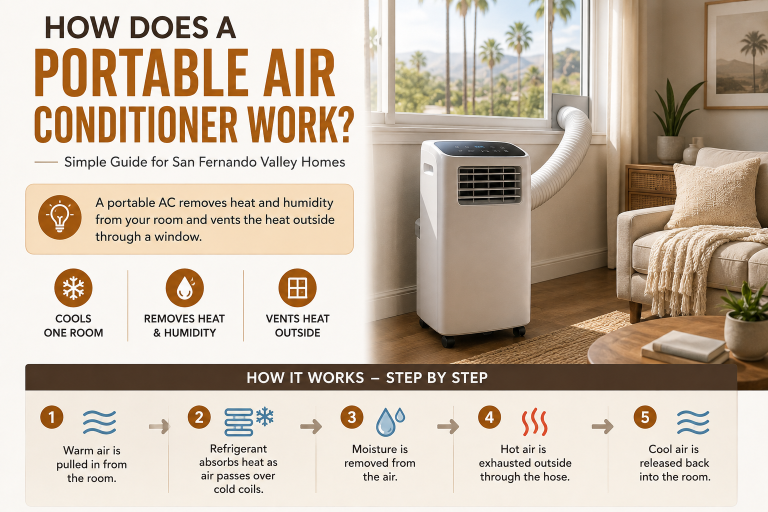
A window unit may cool more efficiently, but not every renter or homeowner wants to install one. If you need flexibility, portability, and a simpler setup, a portable AC can be the better first purchase. If you want to understand the basics better, our guide on how a portable air conditioner works is a helpful place to start.
Portable AC Comparison Checklist for San Fernando Valley Shoppers
Must-check specs: BTU, hose type, coverage area, energy use, and warranty
Before you buy, compare the specs that actually affect daily use. BTU tells you about cooling strength, hose type affects efficiency, and coverage area gives you a rough idea of fit.
Warranty and energy use matter too, especially if you expect long summer runs. In a place like the SFV, a slightly better warranty can be worth more than a flashy feature you’ll never use.
- BTU rating matched to the room
- Single-hose or dual-hose design
- Coverage area and room fit
- Energy use and efficiency features
- Warranty length and support
Convenience features: caster wheels, timers, sleep mode, and smart controls
Convenience features can make a big difference if you plan to use the unit often. Caster wheels help when moving between rooms, timers help avoid wasted runtime, and sleep mode can make nighttime use more comfortable.
Smart controls are nice, but they shouldn’t outrank the basics. A simple unit that cools well is usually a better buy than a feature-heavy model that struggles in Valley heat.
Price vs performance tradeoffs for budget, midrange, and premium models
Budget units can be fine for occasional use or smaller rooms, but they may be louder or less efficient. Midrange models often hit the best balance for most first-time buyers.
Premium units may be worth it for large bedrooms, home offices, or garages where the AC runs often and comfort matters more. The right choice depends on how many hours a day you expect to use it and how demanding the room is.
How to Use a Portable AC Efficiently in SFV Homes and Outdoor Living Spaces
Cooling strategies for patios, garage gyms, and backyard gatherings
Portable ACs work best in enclosed or semi-enclosed spaces, so think of them as zone coolers. A garage gym, enclosed patio, or shaded hangout area can benefit a lot more than an open backyard with no walls.
For gatherings, use the AC to cool the area where people sit most often. That’s usually more effective than trying to chill every corner of a large space.
Pairing portable AC with blackout curtains, shade, and evening ventilation
In the Valley, one of the smartest moves is to reduce heat before the AC ever turns on. Blackout curtains, exterior shade, and closing blinds during peak sun can cut down the load on the unit.
Then, when temperatures drop in the evening, use ventilation strategically. Letting cooler air in at the right time can help the room recover faster and reduce how hard the portable AC has to work.
If your room faces west, close blinds early in the afternoon and run the portable AC before the room gets fully heat-soaked. Waiting until the space is already blazing hot makes the unit work much harder.
Seasonal maintenance tips for dusty Valley conditions and long summer runs
Dust is a real issue in the SFV, especially if the unit sits near an open window, garage door, or patio door. Clean filters regularly so airflow stays strong and the machine doesn’t have to strain.
Check the hose, window seal, and drain path during the season, not just at the start. A few minutes of maintenance can help the unit last longer and work better through a long hot spell.
Final Practical Recap: The Best Portable AC Buying Approach for First-Time Buyers
Quick decision framework based on room size, lifestyle, and budget
The easiest way to choose is to start with the room and your daily routine. Small bedrooms usually need quieter, simpler units; hotter rooms with sun exposure often need stronger cooling and better hose design; and garages or ADUs may need the most careful setup.
If you’re on a budget, focus on fit and reliability first. If you can spend more, pay for better efficiency, lower noise, and a stronger window seal.
What SFV buyers should prioritize before purchasing in 2026
For San Fernando Valley buyers in 2026, the biggest priorities are still the basics: correct size, good exhaust setup, manageable noise, and enough cooling power for real local heat. Features are nice, but they should support comfort, not distract from it.
First-time buyers who keep those priorities in mind usually end up happier with their purchase. In this climate, a well-matched portable AC is less about luxury and more about making summer livable.
Recommended Products
SHOP THIS SETUP
Whynter ARC-14S 14,000 BTU Dual Hose Portable Air Conditioner
This model stands out for first-time buyers because the dual-hose design cools more efficiently than many single-hose units, which is especially helpful during hot San Fernando Valley summers. It also includes a dehumidifier mode and a strong cooling capacity that makes it a solid pick for bedrooms, home offices, and medium-sized living spaces.
Frequently Asked Questions
Start with the room’s square footage, then adjust for sun exposure, ceiling height, and how hot the room gets in the afternoon. Bedrooms with west-facing windows or weak insulation often need more cooling than the basic size chart suggests.
Often, yes. Dual-hose units usually cool more efficiently in hotter spaces because they handle intake and exhaust separately.
Many are louder than central AC, and some are louder than others. If you plan to use one in a bedroom or home office, check noise level carefully before buying.
Yes, especially when you need cooling without a permanent installation. They’re a practical choice for renters, shared homes, and small spaces with limited window options.
Seal the window kit well, keep the hose short and straight, and reduce heat with curtains or shade before turning the unit on. Regular filter cleaning also helps performance during long summer runs.
Choose a window unit if you want stronger efficiency and you’re allowed to install one. A portable AC is usually better when you need flexibility, easier setup, or a renter-friendly option.