What Is a Portable Air Conditioner

A portable air conditioner is a movable room-cooling unit that vents hot air outside through a hose and window kit. In the San Fernando Valley, it is usually best for one hot room, a rental, or a temporary setup rather than whole-home cooling.
If you live in the San Fernando Valley, you already know how fast a warm afternoon can turn into a full-on heat check. A portable air conditioner is a movable cooling unit that sits inside your room, pulls in warm air, and pushes hot air out through a hose and window vent.
For SFV renters, homeowners, and anyone dealing with a garage office, ADU, or tricky window setup, it can be a practical way to cool one space without installing a permanent system. It is not a magic whole-house solution, but in the right room and the right conditions, it can make summer a lot more manageable.
- Room-by-room use: Best for bedrooms, offices, garages, and ADUs.
- Vent matters: Proper exhaust setup is essential for real cooling.
- SFV fit: Good for rentals and older homes with limited options.
- Expectations: Helpful, but not a whole-house replacement.
What Is a Portable Air Conditioner and Why SFV Residents Are Searching for One in 2026
A portable air conditioner is a self-contained cooling appliance on wheels. Instead of being mounted in a wall or window, it stays on the floor and vents heat outdoors through an exhaust hose.
People in the San Fernando Valley keep searching for them because local housing is so varied. Some residents live in apartments with limited window options, others rent homes where permanent upgrades are off-limits, and plenty of households need a flexible backup for hot bedrooms, offices, or bonus rooms.
How portable ACs fit San Fernando Valley home life, apartments, and rental spaces
SFV living often means dealing with older windows, sliding glass doors, shared walls, and rooms that heat up fast in the afternoon sun. A portable AC can be a good fit when you need cooling without changing the structure of the home.
That flexibility matters in rentals, accessory dwelling units, and homes where you may not want to invest in a full mini-split. It also helps if you only need cooling in one area at a time, such as a bedroom at night or a home office during the workday.
Reader intent: understanding the basics before buying or using one
Most people asking what is a portable air conditioner are trying to figure out the basics before spending money. They want to know how it works, whether it will actually cool a Valley room, and how it compares with other options.
If that sounds like you, start with the fundamentals before shopping. Our guide on portable air conditioner how it works breaks down the mechanics in more detail.
How a Portable Air Conditioner Works in Hot, Dry San Fernando Valley Weather
Portable ACs work by pulling warm indoor air over cold coils, removing heat, and sending that heat outside through an exhaust hose. The cooled air is then blown back into the room.
In the San Fernando Valley, that process matters because heat builds quickly, especially in rooms with strong sun exposure. A unit that seems fine on a mild day may feel underpowered when the afternoon temperature climbs and the room has been baking for hours.
Key parts: compressor, exhaust hose, water collection, and venting
The compressor does the heavy lifting by moving heat out of the room. The exhaust hose carries that heat to a window vent kit, which is why proper venting is so important.
Most units also collect moisture from the air. Some drain it manually, some evaporate part of it, and some need a hose or bucket setup depending on use and humidity. If you want a deeper breakdown of the components, see our article on how a portable air conditioner works.
Why SFV heat waves and low-humidity afternoons change cooling needs
Hot, dry weather changes the way comfort feels. Even if humidity is lower than in coastal or inland-humid climates, intense heat and direct sun still raise indoor temperatures fast, especially in west-facing rooms.
That means SFV buyers should think beyond the label and focus on real room conditions. A portable AC can help a lot, but it works best when the room is closed off, shaded when possible, and sized appropriately for the space.
Portable ACs need a clear exhaust path. If the hot air hose leaks, bends too sharply, or vents poorly, the unit can work harder and cool less effectively.
Where a Portable AC Makes the Most Sense in SFV Homes and Daily Life
The best use for a portable AC is usually one room at a time. That makes it especially useful in homes where cooling the entire property would be expensive or unnecessary.
In the Valley, that often means targeting the spaces that get the most sun, the most use, or the most heat from people and appliances.
Bedrooms, home offices, garages, ADUs, and bonus rooms
Bedrooms are one of the most common places to use a portable AC because sleep is harder when a room holds heat late into the night. Home offices are another smart use, especially for remote workers who need comfort during long afternoons.
Garages, converted bonus rooms, and ADUs can also be good candidates if they are used regularly and have a safe way to vent outdoors. These spaces often lack the insulation or ductwork of the main home, so a portable unit can be a practical stopgap.
Outdoor living overflow: patios, enclosed sunrooms, and family gatherings
Portable ACs are not designed for open patios, but they can help in enclosed sunrooms or enclosed outdoor living spaces that get too warm during gatherings. If the area is partially sealed and vented correctly, they can improve comfort for guests.
That said, if a space is mostly open to the outside, a portable AC will struggle. For true outdoor cooling, shade, fans, and airflow usually matter more than trying to chill open air.
Kitchen heat during cooking, meal prep, and summer entertaining
Summer cooking can turn a kitchen into the hottest room in the house. A portable AC placed nearby, but not blocked by steam or grease, can help offset some of that heat during meal prep or entertaining.
This works best when the kitchen can be closed off from the rest of the home. If not, the unit may fight against open doors and constant heat from appliances.
Short-term cooling for cars, moving days, and temporary setups
Portable ACs can also help in temporary situations, such as moving into a new place, setting up a short-term workspace, or cooling a room before a larger system is installed. They are not meant for cars, but they can help nearby indoor staging areas, garages, or loading spaces where people are coming and going.
For families doing a summer move in the Valley, that flexibility can be a relief. Just remember that the unit still needs power, venting, and enough time to cool the space.
If you are cooling a bedroom or office in the SFV, close doors early and start the portable AC before the room gets fully heat-soaked. It usually performs better than trying to cool a space after sunset heat has already built up.
Portable AC vs. Window AC vs. Swamp Cooler vs. Mini-Split for SFV Conditions
Choosing the right cooling option in the San Fernando Valley comes down to your room, your budget, and how permanent you want the solution to be. Each option has trade-offs.
The best choice for one household may be a poor fit for another, especially in older homes, apartments, and rentals.
Cooling power, installation effort, noise, and energy use
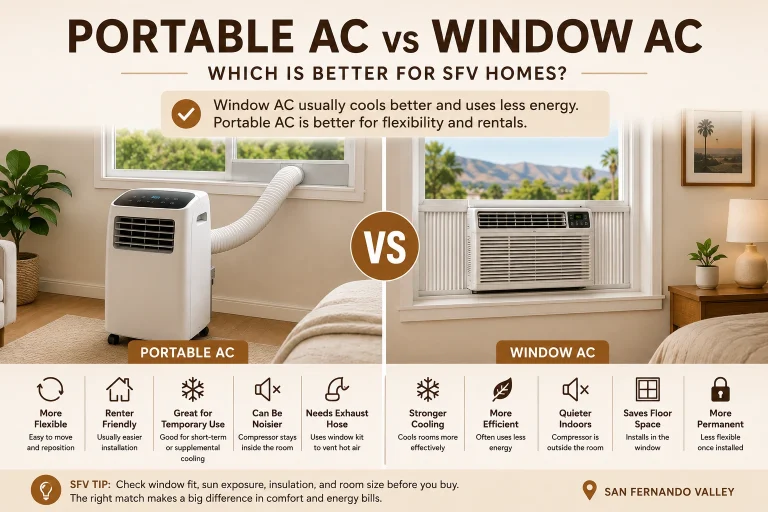
| Option | Best For | Note |
|---|---|---|
| Portable AC | Renters, single rooms, flexible setups | Easy to move, but usually noisier and less efficient than permanent systems |
| Window AC | Small rooms with suitable windows | Often more efficient, but blocks part of the window |
| Swamp cooler | Very dry conditions and open airflow | Can help in some Valley setups, but performance depends on humidity and ventilation |
| Mini-split | Long-term comfort and targeted room cooling | Higher upfront commitment, but often the cleanest and most effective solution |
Which option works best for older SFV homes, apartments, and rentals
Older homes may have limited electrical or window layouts, which can make portable ACs attractive because they do not require major remodeling. Apartments and rentals often favor portable units for the same reason: less installation friction and fewer lease concerns.
Window units can cool efficiently, but not every window style works well. Mini-splits are excellent for many homes, but they are a bigger project and usually make more sense when you plan to stay put.
When a portable AC is a practical compromise instead of a permanent upgrade
A portable AC is often the middle-ground choice when you need cooling now but do not want a permanent installation. That makes it appealing for new homeowners, renters, and families waiting to decide on a bigger upgrade.
If you are still asking whether they work well in real Valley conditions, our guide on do portable air conditioners work well is a useful next read.
What SFV Buyers Should Look for Before Choosing a Portable Air Conditioner
Buying the right portable AC is less about flashy features and more about matching the unit to the room and your daily routine. In the Valley, that usually means accounting for sun, room size, and how often you will run it.
Budget, mid-range, and premium models can all make sense depending on the space. Prices and availability vary by season, store, and neighborhood demand, especially during peak heat.
Room size, BTU rating, and real-world cooling expectations
BTU rating is one of the first things shoppers notice, but bigger is not always better. A unit that is too small will struggle, while one that is oversized for the room may cycle inefficiently and still fail to feel comfortable.
Think about the actual room: ceiling height, sun exposure, number of people, electronics, and whether doors stay open. A shaded bedroom is very different from a west-facing living room with large windows.
- Room square footage and ceiling height
- Sun exposure during the hottest part of the day
- Whether the room stays closed or opens into other areas
- How often you plan to use the unit
- Whether you need portability or permanent cooling
Single-hose vs. dual-hose models for faster cooling in Valley heat
Single-hose models are common and usually simpler to set up, but they can pull conditioned air from the room to help exhaust heat. Dual-hose models often cool more efficiently because they separate intake and exhaust airflow.
For SFV heat, that difference can matter. If you expect regular use during hot afternoons, a dual-hose model may be worth considering, especially for rooms that already run warm.
Drainage, dehumidifying, and filter maintenance for dust-prone neighborhoods
Even in dry weather, portable ACs collect moisture and need maintenance. Some units require periodic draining, while others have self-evaporative features that reduce how often you deal with water.
Dust is another Valley reality. Filters can clog faster than many buyers expect, especially if windows are open often or the unit sits in a garage, near a busy street, or in a pet-friendly home.
Noise levels for sleeping families, remote work, and apartment living
Noise matters a lot in apartments, bedrooms, and home offices. Portable ACs usually make more sound than a central system because the compressor sits in the room with you.
If you are sensitive to noise, look for quieter operation and think about where the unit will sit. A slightly louder model may be fine in a garage office but annoying in a small bedroom at night.
Installation and Everyday Use Tips for Better Cooling in the Valley
Even a decent portable AC can underperform if it is installed badly or used in a heat-soaked room. A little setup work goes a long way in SFV homes.
The goal is to keep hot air out, cool air in, and the unit working as efficiently as possible.
Proper window venting for sliding windows, older frames, and rentals
Most portable ACs include a window kit, but not every window style is equally cooperative. Sliding windows are often the easiest fit, while older frames may need extra attention to seal gaps.
In rentals, avoid makeshift setups that damage the frame or leave large openings. A tight vent seal helps the unit cool better and prevents hot outdoor air from sneaking back in.
Keep the hose as straight and short as the manufacturer allows.
Close gaps around the vent kit so hot air does not leak back inside.
Start early enough that the room does not become fully overheated first.
Keeping cool air in and hot air out during peak afternoon heat
Close doors, keep blinds down, and avoid opening windows once the unit is running. In the Valley, a room can heat up quickly when direct sun hits it, so blocking that sunlight helps more than people expect.
If you can, cool the room before the hottest part of the day. That is often easier than trying to recover from a long stretch of afternoon heat.
Using curtains, fans, and shade to improve performance in SFV homes
Blackout curtains, reflective shades, and ceiling or box fans can all help a portable AC do less work. Fans do not lower the temperature, but they help move cooled air around the room.
Shade matters too. A west-facing room with no window covering will usually challenge even a decent unit. Reducing sun load is one of the simplest ways to improve comfort.
In dry Valley weather, a room may feel more comfortable when airflow is improved, even before the thermostat drops dramatically. That is why fans and vent sealing can make a noticeable difference.
Energy-saving habits during high summer electric demand
Portable ACs can add to summer electric use, especially when they run for hours at a time. Using them strategically in one occupied room is usually smarter than trying to cool empty spaces.
Set reasonable temperatures, clean the filter, and shut doors behind you. Small habits can help reduce strain on the unit and keep the room more stable through long hot stretches.
Common Mistakes SFV Residents Make When Buying or Using Portable ACs
Portable ACs are convenient, but a few common mistakes can make them feel disappointing. Most of those problems come from mismatched expectations rather than bad products.
Knowing the usual pitfalls can save money and frustration.
Choosing the wrong size for large living rooms or open floor plans
A single portable AC usually works best in a defined room, not a wide-open layout. Large living rooms and open-plan spaces often leak cool air too quickly for one unit to handle well.
If the room is too big or too open, the unit may run constantly without ever feeling truly comfortable.
Ignoring exhaust setup, hose length, and airflow restrictions
The exhaust hose is not a small detail. If it is too long, bent, crushed behind furniture, or poorly sealed, the unit loses efficiency fast.
Airflow around the intake and exhaust also matters. Do not push the unit into a tight corner where it cannot breathe.
- Keep the hose short and straight
- Seal the window kit tightly
- Leave space around the unit
- Running the hose through a messy gap
- Blocking the intake or exhaust
- Assuming setup does not matter
Expecting whole-home cooling from a single portable unit
One portable AC can be great for one room, but it is not usually a whole-house answer. That is the biggest expectation gap for many first-time buyers.
For families in the Valley, the best approach is often to think zone by zone: bedroom, office, nursery, or den. If you need whole-home comfort, a more permanent system may be the better long-term path.
Overlooking maintenance in dusty, high-use summer conditions
Filters, drainage, and vent seals need attention, especially in dusty, high-use months. If you ignore maintenance, the unit may get louder, less efficient, and less reliable over time.
That is especially true in garages, homes near busy roads, or households with pets. A little upkeep can make a big difference in performance.
Practical Recap: Is a Portable Air Conditioner Worth It for Your SFV Home?
For many San Fernando Valley residents, a portable AC is worth it when flexibility matters more than perfection. It is especially useful if you rent, need a quick setup, or only want to cool one room at a time.
If your home has a tricky window layout, a hot office, or a bedroom that bakes in the afternoon sun, it can be a smart and realistic solution.
Quick decision guide for families, renters, commuters, and outdoor-focused households
Families often like portable ACs for bedrooms and bonus rooms. Renters appreciate the lower-commitment setup, and commuters who come home to a hot house may like the ability to cool one space first.
Outdoor-focused households may also use them to support enclosed patios, sunrooms, or gathering spaces, as long as venting is possible and the area is not fully open to the outside.
Best-use scenarios for 2026 San Fernando Valley living
In 2026, the best portable AC use cases in the Valley still look familiar: apartments, ADUs, home offices, garages, and rooms that get hammered by afternoon sun. They are also useful as a bridge solution while you plan something bigger.
For many households, that mix of portability and convenience is the real value.
Final takeaway on comfort, flexibility, and realistic cooling performance
A portable air conditioner is best understood as a flexible, room-by-room cooling tool. It is not the most powerful or quietest option, but it can be the most practical one for SFV living.
If you choose the right size, vent it properly, and use it in the right space, it can make hot Valley days a lot easier to handle.
Recommended Products
SHOP THIS SETUP
Whynter ARC-14S 14,000 BTU Dual Hose Portable Air Conditioner
This model stands out because its dual-hose design cools more efficiently than many single-hose portable units, which can matter during hot San Fernando Valley afternoons. It also includes dehumidifying and fan modes, making it a versatile choice for apartments, bedrooms, or home offices where window AC installation isn’t practical.
Frequently Asked Questions
A portable air conditioner is used to cool one room or enclosed space without installing a permanent system. It is common in bedrooms, offices, apartments, and rentals.
They can work well in the San Fernando Valley when the room is the right size and the unit is vented correctly. They are best for targeted cooling, not whole-home comfort.
Yes, most portable air conditioners need to vent hot air outside through a hose and window kit. Without proper venting, they lose efficiency and cool less effectively.
It depends on your space and priorities. Portable units are easier to move and better for rentals, while window units are often more efficient for a single room.
Portable air conditioners are usually noisier than central air because the compressor stays in the room. Noise levels vary, so they may be fine for a garage office but less ideal for light sleepers.
The right size depends on room square footage, ceiling height, sun exposure, and how many people use the space. A unit that is too small will struggle, while one that is too large may not feel efficient.