Are Portable Air Conditioners Effective? SFV Cooling Guide

- Best use: Cooling one closed room.
- Best fit: Bedrooms, offices, apartments, ADUs, and bonus rooms.
- Main advantage: Flexible setup without permanent HVAC installation.
- Main drawback: More noise and usually lower efficiency than many window AC units.
- Biggest performance factor: Correct sizing and a well-sealed exhaust setup.
If you are wondering are portable air conditioners effective, the answer depends heavily on what you expect the unit to do.
A portable AC can make a hot bedroom or home office much more comfortable, but it is not designed to cool an entire house from one location. In the San Fernando Valley, where afternoon sun and stored heat can make individual rooms uncomfortable well into the evening, portable cooling works best when you focus on one specific space.
The right room, the right capacity, proper venting, and good heat control can make the difference between a portable AC that feels useful and one that seems disappointing.
Are Portable Air Conditioners Effective in San Fernando Valley Homes?
Yes, portable air conditioners can be effective in San Fernando Valley homes when they are matched to the room and installed correctly.
The strongest use case is targeted cooling. Instead of trying to cool every room in the home, a portable AC works on the bedroom, office, ADU, or other space where you need relief most.
Performance usually drops when the unit is placed in a large open area, a room with strong uncontrolled sunlight, or a space where doors and windows constantly allow warm air back in.
The most important expectation to set
Where Portable AC Units Work Best
Bedrooms
Bedrooms are one of the strongest applications for portable air conditioners because the door can usually remain closed while the unit runs.
Blackout curtains or shades can also reduce heat gain before bedtime, especially in rooms that receive strong afternoon sun.
Home Offices
A home office is another good match because you may only need cooling during certain working hours. Instead of cooling the entire home, you can concentrate comfort in the space where you spend the day.
Noise matters here, though. Because the compressor is inside the room, check operating-noise specifications if you spend a lot of time on calls or video meetings.
Apartments and Rentals
Portable air conditioners appeal to renters because they generally require less permanent installation than many other cooling systems.
You still need an appropriate way to vent hot air outdoors, and it is worth checking building or lease rules before installing a window kit.
ADUs, Bonus Rooms, and Converted Spaces
ADUs, converted garages, bonus rooms, and similar spaces often need targeted cooling rather than a complete HVAC upgrade.
A portable unit can be useful in these rooms if the space is reasonably enclosed and the AC has enough rated capacity for the actual heat load.
Garages
A portable AC may improve comfort in an enclosed garage, but garages can be difficult cooling environments because of insulation, doors, sun exposure, and stored heat.
If the garage has large air leaks or remains open, a room air conditioner will struggle to maintain comfortable conditions.
Where Portable Air Conditioners Struggle
Large Open Floor Plans
Portable ACs are much less convincing when cold air can immediately escape into hallways, kitchens, or adjacent living areas.
The larger and more open the space, the more cooling capacity is required and the harder it becomes for one portable unit to maintain a noticeable temperature difference.
Rooms With Heavy Afternoon Sun
West-facing windows and strong direct sun can continuously add heat while the AC is trying to remove it.
Closing blinds, curtains, or shades can significantly improve the conditions the portable unit has to work against.
Semi-Outdoor Spaces
A portable air conditioner is not a good substitute for outdoor cooling equipment on an open patio.
It may help an enclosed sunroom or porch if the area behaves more like an indoor room, but it will struggle in a space that constantly exchanges air with the outdoors.
What Makes a Portable AC More Effective?
- Choose a model suitable for the room size.
- Install the window vent kit tightly.
- Keep the room door closed when possible.
- Block strong direct sunlight.
- Keep the exhaust hose arranged according to the manufacturer’s instructions.
- Clean the filter regularly.
- Keep air intake and outlet areas unobstructed.
- Reduce unnecessary heat from appliances when possible.
Why Vent Sealing Matters So Much
A portable air conditioner removes heat from the room and sends that heat outdoors through its exhaust system.
If the window kit has large gaps, warm outdoor air can leak back into the room. That forces the AC to fight against additional heat while it is already working to cool the space.
If you want to understand the cooling cycle itself, read our guide on how a portable air conditioner works.
Single-Hose vs Dual-Hose Portable AC
Portable air conditioners are commonly available in single-hose and dual-hose designs.
| Feature | Single-Hose | Dual-Hose |
|---|---|---|
| Setup | Usually simpler | More components to install |
| Air management | Uses indoor air as part of the cooling process | Separates intake and exhaust more effectively |
| Hot-room performance | Can work well for lighter cooling needs | Often worth considering for tougher conditions |
| Best for | Smaller or moderate cooling needs | Rooms with heavier heat loads |
The number of hoses should not be your only buying criterion. Compare room coverage, current cooling ratings, noise, installation requirements, and manufacturer guidance as well.
Portable AC vs Window AC vs Mini-Split
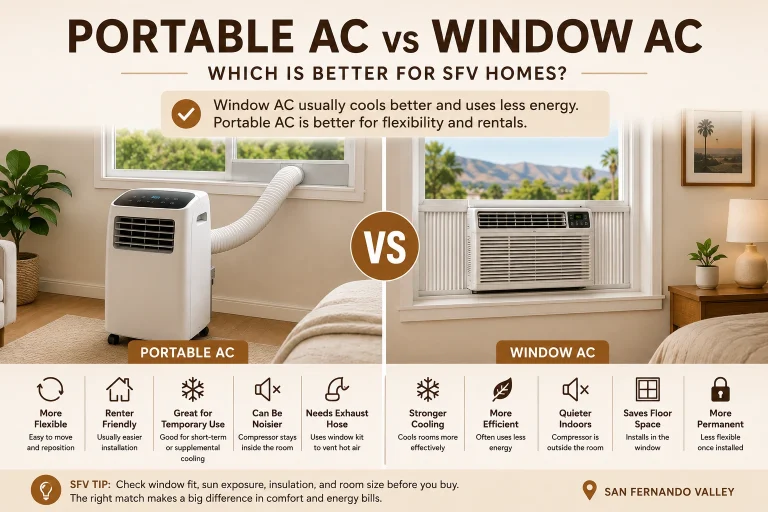
A portable air conditioner is usually chosen for flexibility and convenience rather than maximum efficiency.
| Cooling Option | Best For | Main Trade-Off |
|---|---|---|
| Portable AC | Renters, one-room cooling, temporary use | Uses floor space and can be noisy |
| Window AC | Dedicated room cooling | Requires suitable window installation |
| Mini-split | Long-term zoned cooling | Higher installation commitment |
How to Choose the Right Portable Air Conditioner
The room’s square footage is important, but it is not the only factor that affects cooling demand.
- Room size
- Ceiling height
- Window size and orientation
- Direct sunlight
- Insulation
- Number of occupants
- Computers and other heat-producing equipment
- Whether the room can be closed off
A sunny upstairs bedroom can have a much heavier cooling load than a shaded room with the same floor area.
Does a Bigger Portable AC Always Cool Better?
Not necessarily. Undersizing is a common problem, but simply buying the largest available portable AC is not automatically the right solution.
The better approach is to match the unit to the actual room conditions and follow the manufacturer’s sizing recommendations.
If the room is unusually sunny, poorly insulated, or filled with heat-producing equipment, those factors should be considered before purchase.
Are Portable Air Conditioners Noisy?
Noise is one of the biggest trade-offs with portable air conditioners because the compressor and other operating components sit inside the room.
That may not matter much in a garage or casual living space, but it can be important in:
- Bedrooms
- Nurseries
- Home offices
- Rooms used for video calls
- Spaces used by light sleepers
If noise matters, compare the manufacturer’s current sound specifications and available sleep or quiet modes before purchasing.
How to Make a Portable AC Work Better in SFV Heat
- Seal gaps around the window kit.
- Close the room door.
- Use curtains or blinds on sunny windows.
- Clean the AC filter regularly.
- Keep the exhaust path as practical as the manual recommends.
- Use a fan if needed to distribute cool air within the room.
- Trying to cool a wide-open floor plan with one small unit.
- Leaving major gaps around the exhaust window.
- Blocking the intake or cold-air outlet.
- Running heat-producing appliances unnecessarily.
- Expecting one portable unit to cool several separate rooms.
Should You Pre-Cool the Room?
If your schedule allows it, cooling the room before it reaches its hottest point can make the space more comfortable later.
Waiting until a west-facing bedroom has absorbed hours of afternoon sun means the AC has to cool both the air and the heat stored in surrounding surfaces.
Who Should Consider a Portable Air Conditioner?
- You only need to cool one room.
- You rent or want a less permanent setup.
- A window AC is not practical.
- You need temporary or supplemental cooling.
- You want targeted bedroom or office comfort.
- You need whole-home cooling.
- You want to cool several rooms simultaneously.
- Very quiet operation is a top priority.
- You want a long-term permanently installed solution.
- Your space cannot be properly vented outdoors.
Portable AC Options to Consider
A portable AC option to compare for smaller-space cooling. Check the current manufacturer rating, room coverage, hose setup, and specifications before ordering.
Check Current Price
A dual-hose option worth comparing when you want stronger portable cooling performance. Confirm current specifications and room coverage before purchase.
Check Current Price
Are Portable Air Conditioners Effective? Final Verdict
Portable air conditioners can be effective, but they work best when your expectations match the equipment.
For an enclosed bedroom, office, apartment room, ADU, or other contained space, a correctly sized and properly vented portable AC can provide meaningful relief during hot San Fernando Valley weather.
They become much less attractive when you expect one unit to cool a large open layout or several rooms at once.
Frequently Asked Questions
Yes. They can be effective for cooling one properly sized enclosed room, especially when the exhaust is correctly installed and the room is protected from excessive heat gain.
Usually, portable units perform better as single-room coolers. Cooling an entire apartment depends on its size, layout, insulation, and the unit’s rated capacity.
Bedrooms are often a strong use case because they can be closed off. Noise level should also be considered if you plan to run the unit while sleeping.
Dual-hose designs can manage intake and exhaust differently from single-hose models and may be worth considering for more demanding cooling conditions. Compare the complete specifications of individual models.
Common factors include incorrect sizing, direct sunlight, poor window sealing, blocked airflow, a dirty filter, open doors, or a difficult room layout.
Many portable AC units produce noticeable noise because the compressor is inside the room. Compare current sound ratings if you plan to use one in a bedroom or office.