Portable Air Conditioner Energy Efficiency Tips

Portable air conditioner energy efficiency starts with the right size unit, a tight seal, and smart daily settings. In San Fernando Valley heat, the biggest savings come from cooling only the room you need and blocking heat before it enters.
Portable air conditioners can be a smart way to beat San Fernando Valley heat, especially when you only need to cool one room at a time. The trick is using them efficiently, because in the SFV, hot afternoons, dry air, west-facing windows, and summer power bills can all work against you if the unit is oversized, under-sealed, or running longer than it needs to.
If you want better comfort without wasting energy, the biggest wins usually come from setup, sizing, and daily habits. A little planning goes a long way in bedrooms, ADUs, garages, home offices, and apartment spaces where a full central system is not the most practical option.
- Size matters: Match the unit to the room to avoid wasted energy.
- Seal first: Close gaps around windows, doors, and exhaust kits.
- Use smart modes: Timers, sleep mode, and eco settings reduce runtime.
- Cut heat load: Curtains, shade, and fans help the AC work less.
- Maintain often: Clean filters and check hoses for better airflow.
Why Portable AC Efficiency Matters in San Fernando Valley Homes in 2026
How SFV heat waves, dry afternoons, and power costs shape cooling choices
The San Fernando Valley has a way of turning a warm day into a brutally hot afternoon, especially when the sun hits west-facing rooms and the heat hangs around after sunset. Portable ACs can help, but they work best when you treat them like zone coolers, not whole-home replacements.
That matters even more in 2026, when many households are trying to balance comfort with monthly utility costs. For renters, families, and hybrid workers across the Valley, energy efficiency is not just about being eco-friendly; it is about keeping one room livable without making the rest of the house feel like a furnace.
What readers want: lower bills, better comfort, and less strain on the unit
Most people are looking for the same three things: a lower bill, a cooler room, and a unit that does not seem to run nonstop. Portable AC efficiency helps with all three. When the unit is matched to the room and used correctly, it cycles less, cools faster, and tends to last longer.
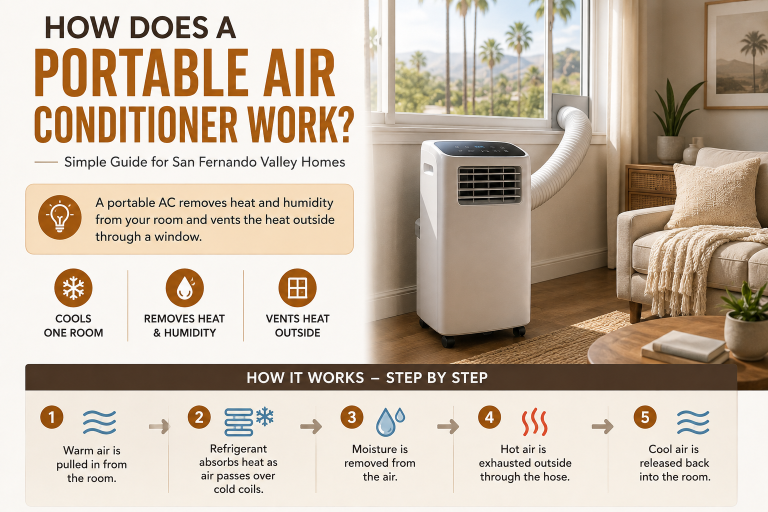
For a deeper look at the basics, it helps to understand how a portable air conditioner works. Once you know what the exhaust hose, intake, and condensation system are doing, the energy-saving tips make a lot more sense.
Start with the Right Portable Air Conditioner for Your Space
BTU sizing for SFV bedrooms, ADUs, garages, and home offices
The most efficient portable AC is the one that fits the room. Too small, and it runs all day without really catching up. Too large, and it may short-cycle, which can leave the room clammy and waste energy.
In the SFV, room type matters as much as square footage. A shaded bedroom will not need the same cooling power as a sun-baked garage office, an upstairs ADU, or a family room with large glass sliders.
- Room size and ceiling height
- Sun exposure, especially west-facing windows
- Number of people using the room
- Heat from electronics, cooking, or laundry
- Whether the space is insulated or drafty
Single-hose vs. dual-hose models for Valley apartments and family rooms
Single-hose units are common because they are easier to move and usually cost less upfront. The trade-off is that they pull indoor air out of the room, which can create negative pressure and make the unit work harder in hot, leaky spaces.
Dual-hose models are often a better fit for larger rooms or hotter Valley apartments because they are generally more efficient at cooling the space they are actually in. If you live in a sun-exposed apartment or use the unit in a family room with lots of traffic, the extra upfront cost can be worth it over a long summer.
| Option | Best For | Note |
|---|---|---|
| Single-hose | Smaller bedrooms and occasional use | Usually easier to buy and move, but less efficient in hot rooms |
| Dual-hose | Hotter spaces and longer daily runtime | Often better cooling performance, especially in the Valley heat |
Energy Star ratings, inverter tech, and features worth paying for
Energy Star certification is a useful starting point when comparing portable ACs, though it should not be the only thing you look at. Inverter technology, if available, can help the unit run more smoothly instead of constantly blasting on and off.
Other features worth paying for include a good timer, sleep mode, eco mode, and a clear drain setup. These are the kinds of details that help in real life, especially when you are trying to cool one room at night without freezing it or wasting electricity.
Portable Air Conditioner Energy Efficiency Tips for Daily Use
Seal windows, sliding doors, and vents before turning the unit on
One of the easiest ways to waste energy is to let cooled air leak out while hot air leaks in. Before you turn the unit on, check windows, sliding doors, vent gaps, and any loose seals around the exhaust kit.
This matters a lot in older SFV homes and rentals where weatherstripping may be worn out. Even a small gap can make the unit work harder during a long afternoon heat stretch.
In Valley apartments with sliding doors, use the best-fitting window kit you can get and add temporary sealing tape where air sneaks around the edges.
Set the thermostat smartly for hot afternoons and cooler evenings
Do not assume the coldest setting is the most efficient. In many SFV homes, a moderate target temperature is enough once the room is pre-cooled and the sun starts dropping.
On the hottest afternoons, it can help to start the unit a little earlier rather than waiting until the room is already overheated. Then, as the evening cools down, raise the setting slightly or switch to a gentler mode so the unit does not keep overworking.
Use fan mode, sleep mode, and timer settings to reduce runtime
Fan mode is useful when you mainly want air movement, not full cooling. Sleep mode can also make a big difference at night by reducing noise and easing off the compressor after the room has stabilized.
Timers are one of the most underrated energy-saving tools on portable ACs. If you know you only need cooling for a few hours, set the unit to shut off automatically instead of letting it run until morning.
Run the AC strategically around cooking, laundry, and family activity
Portable ACs are more efficient when they are not fighting extra heat sources. If possible, avoid running them at the same time as oven-heavy cooking, long dryer cycles, or other high-heat activities in nearby rooms.
That is especially helpful in Valley kitchens and bonus rooms that already hold heat well. Cooling a room before the busiest part of the day often uses less energy than trying to recover from a spike in heat later.
If your portable AC seems to run constantly even after basic sealing and setup, the room may simply be too hot, too large, or too exposed for the unit you chose.
Improve Cooling in SFV Rooms Without Overworking the Unit
Shade, blackout curtains, and reflective window coverings for west-facing rooms
West-facing rooms are a common problem in the Valley because they take the full hit of afternoon sun. Blackout curtains, reflective shades, and even simple window film can reduce the heat load before the AC ever turns on.
This is one of the best energy efficiency moves because it lowers the amount of heat entering the room in the first place. In other words, the AC gets to do less work.
Ceiling fans, box fans, and cross-ventilation for morning and evening comfort
Fans do not replace air conditioning, but they can help you feel cooler at a higher thermostat setting. That means the portable AC can run less often while still keeping the room comfortable.
In the SFV, early mornings and late evenings are often the best times for cross-ventilation. If outdoor air is cooler and not too smoky, opening windows briefly can help flush out trapped heat before you close things up and run the AC again.
During wildfire-smoke days or heavy smog, skip the open-window strategy and keep indoor air sealed as much as possible.
Keeping heat sources down in kitchens, garages, and bonus rooms
Garages and bonus rooms are notorious for trapping heat, especially when they are lightly insulated or packed with appliances and storage. If you are cooling one of these spaces, reduce extra heat wherever you can.
That means turning off unused electronics, limiting incandescent lighting, and keeping doors closed to hotter areas of the house. Even small changes can make a portable AC feel much more effective.
Maintenance Habits That Keep Portable ACs Efficient
Cleaning filters during dusty Valley weeks and wildfire-smoke season
Dust is a regular issue in the San Fernando Valley, and smoke season can make filters clog faster than people expect. A dirty filter blocks airflow, which makes the unit work harder and cool less effectively.
Check the filter often during heavy-use months, and clean it according to the manufacturer’s instructions. If the airflow feels weak or the room takes longer to cool, the filter is one of the first things to inspect.
Portable AC efficiency often drops when airflow is restricted, even if the unit still sounds like it is running normally.
Managing exhaust hoses, drainage, and airflow for better performance
The exhaust hose should be as short, straight, and well-sealed as possible. Long, bent, or poorly attached hoses can trap heat and reduce the unit’s cooling ability.
Drainage matters too, especially in humid periods or when the AC is working hard for long stretches. If water backs up or the unit needs constant emptying, performance can suffer and the system may cycle inefficiently.
When to inspect seals, wheels, and connectors for energy loss
It is easy to ignore the small parts, but loose connectors and worn seals can quietly waste energy. If the window kit shifts, the hose adapter loosens, or the seals around the kit begin to gap, hot air can creep back in.
Wheels and casters are not an energy feature by themselves, but they matter for portability and placement. If moving the unit to the right room is annoying, people tend to leave it in the wrong spot, which can make the whole setup less efficient.
Best Use Cases for SFV Outdoor Living, Cars, and Commuter Routines
Cooling patio-adjacent spaces, shaded work areas, and backyard gatherings
Portable ACs are not outdoor coolers in the same way a misting fan or patio system might be, but they can help with patio-adjacent rooms, enclosed sunrooms, and shaded workspaces that connect to outdoor living. That is especially useful when you want a cooler zone near the backyard without cooling the entire home.
For family gatherings, think in terms of a comfort zone rather than whole-space cooling. A portable AC in a nearby room can make it easier for guests to step inside and cool off without overcommitting energy to the whole house.
Using portable ACs in RVs, carports, and temporary setups during renovations
Portable ACs can be a practical option for RVs, temporary work areas, and homes under renovation, as long as the setup is safe and well-ventilated. In these situations, efficiency depends even more on sealing and correct venting.
If you are cooling a temporary space in the Valley, keep expectations realistic. A portable unit can make a hot area livable, but it will not do the same job as a properly installed dedicated system in a fully insulated room.
How commuters and hybrid workers can cool specific zones instead of the whole home
Many SFV households do not need every room cooled all day. If one person is home working, studying, or sleeping, it often makes more sense to cool that zone only and let the rest of the house stay warmer.
That zone-based approach is one of the simplest portable air conditioner energy efficiency tips for busy commuters and hybrid workers. It keeps comfort focused where it matters most and avoids paying to cool empty rooms.
Buying Tips: Features That Help SFV Families Save Energy Long-Term
Smart controls, app scheduling, and eco modes for busy households
Smart controls are not essential, but they can be very helpful if your schedule changes a lot. App scheduling, remote access, and eco modes make it easier to turn the unit on only when needed instead of leaving it running out of habit.
If your household has after-school routines, late commutes, or weekend activity swings, those features can save more energy than people expect. They are especially useful when the weather changes fast between afternoon heat and cooler nighttime air.
Noise levels for apartments, kids’ rooms, and shared living spaces
Noise matters more than many buyers realize. A unit that sounds fine during the day may become annoying in a small apartment or a child’s bedroom at night.
Quieter models often cost more, but the extra comfort can be worth it if the AC will run for long stretches. If you share walls with neighbors, or if someone in the home is sensitive to sound, noise level should be part of the buying decision from the start.
For SFV renters and homeowners who want the most practical setup, look for a dual-hose, Energy Star-certified model with a timer, sleep mode, and an easy-to-seal window kit.
Portability, hose length, and installation ease for renters and homeowners
Portability is not just about wheels. It also includes whether the unit fits your room layout, whether the hose reaches the window without awkward bends, and whether you can install it without a complicated setup.
Renters in particular should look for a unit that can be removed cleanly when the lease ends. Homeowners may have more flexibility, but an easy setup still matters if the AC needs to move between a bedroom, office, or garage during the summer.
- Choose the right size for the room
- Seal the window kit tightly
- Use timers and eco modes
- Cool only the room you are using
- Running the unit with gaps around the hose
- Overcooling empty rooms
- Ignoring dirty filters
- Buying based on BTU alone
Practical Recap: The Smartest Efficiency Moves for San Fernando Valley Living
Match the unit to the room, block heat first, and use cooling only where needed
The smartest way to save energy with a portable AC in the SFV is to start with the room, not the machine. Match the unit to the space, seal the leaks, and reduce heat gain with curtains, shade, and fan support before you ask the AC to do all the work.
Choose features that fit SFV weather, family routines, and summer budgets
For many Valley households, the best choice is a model that balances efficiency, noise, and ease of use. If you want better results, focus on the features that match your daily routine, your room layout, and the way San Fernando Valley summers actually feel in real life.
Used well, a portable AC can be a practical cooling tool for bedrooms, apartments, offices, and temporary spaces. The key is not running it harder — it is helping it work smarter.
Recommended Products
SHOP THIS SETUP
BLACK+DECKER Portable Air Conditioner 14,000 BTU with Follow Me Remote
This portable AC is a strong pick for San Fernando Valley heat because its Follow Me remote helps cool the area where you actually spend time, which can reduce wasted runtime. It also pairs well with energy-saving habits like sealing the window vent properly and using a timer, making it a practical choice for renters or rooms without central air.
Frequently Asked Questions
Seal the room first, use the right BTU size, and cool only the space you are using. Timers, eco mode, and clean filters also help the unit run less often.
Often, yes, especially in hotter or leakier rooms. Dual-hose units usually handle Valley heat better because they do not pull as much indoor air out of the room.
Block sun with blackout curtains, seal gaps around windows and doors, and set a moderate temperature instead of the coldest setting. Running the unit only when needed also helps.
Check it often during dusty months or wildfire-smoke season, and clean it whenever airflow starts to drop. In the Valley, filters may need attention more often than people expect.
It can, but only if the space is sized correctly and reasonably sealed. Garages and ADUs often need extra attention because they can trap heat and leak air.
Usually not if you only need one room cooled. Zone cooling is often more efficient, especially for commuters and hybrid workers who are only using part of the home.