Single Hose Vs Dual Hose Portable Ac

Single hose portable ACs are the budget-friendly choice for smaller rooms, while dual hose units usually cool faster and handle SFV heat better. For most San Fernando Valley homes, dual hose is the stronger pick when the room is hot, sunny, or used for long periods.
If you’re trying to cool a San Fernando Valley room without committing to a full HVAC upgrade, the single hose vs dual hose portable ac question matters a lot. In our dry, sun-baked climate, the right choice depends on room size, how much sun the space gets, and whether you need temporary relief or more consistent cooling.
- Best budget pick: Single hose works well for small, easier-to-cool rooms.
- Best performance pick: Dual hose is better for bigger or hotter SFV spaces.
- Setup matters: A good vent seal can make a big difference either way.
- Local reality: Sun exposure and evening heat retention affect cooling more than people expect.
- Smart buy: Match the unit to the room, not just the price tag.
Single Hose Vs Dual Hose Portable AC: What SFV Homes Need to Know in 2026
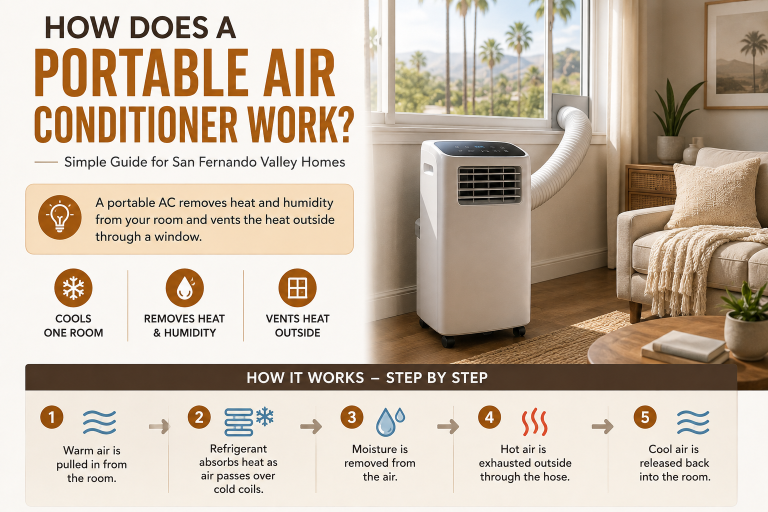
Portable ACs can be a smart fit for SFV homes, but they are not all built the same. The biggest difference is how they move air: single hose units pull indoor air out of the room to cool the system, while dual hose units use one hose to bring in outside air and another to exhaust heat.
That design difference affects cooling speed, efficiency, and how hard the unit has to work in a hot Valley afternoon. If you want a deeper breakdown of the basics, our guide on portable air conditioner how it works is a helpful place to start.
Why Portable Cooling Matters in the San Fernando Valley’s Hot, Dry Climate
SFV summers are a different kind of uncomfortable. The heat can build fast, the sun beats through windows for hours, and many homes hold onto warmth well into the evening.
That means a portable AC is often doing more than just “taking the edge off.” It may be fighting direct sun exposure, warm drywall, older insulation, and rooms that never fully cool down after sunset.
How Valley heat waves, sun exposure, and evening heat retention change cooling needs
In the Valley, a room that feels fine at 9 a.m. can turn rough by midafternoon. South- and west-facing rooms often get the hardest hit, especially in older homes with single-pane windows or limited shade.
Even after the sun drops, indoor heat can linger. That’s why portable AC performance in SFV is less about the number on the box and more about how the room behaves during a real heat wave.
Where portable ACs fit in SFV home life: apartments, ADUs, garages, bedrooms, and home offices
Portable ACs make sense in a lot of local setups: apartments where window units are not ideal, ADUs with limited central cooling, garage conversions, and bedrooms that get too warm at night. They’re also handy for home offices when you only need one room comfortable during work hours.
For renters and people in transitional living situations, the portability is a big plus. You can move the unit seasonally, store it when temperatures ease up, and avoid a more permanent installation.
Single Hose Portable AC: How It Works and Where It Makes Sense
Single hose portable ACs are usually the more affordable and common option. They pull air from inside the room, use it to cool the system, and send the hot air outside through one exhaust hose.
The tradeoff is that removing indoor air creates slight negative pressure, which can pull warmer air back into the room from cracks, doors, or nearby spaces. In a hot Valley home, that can reduce efficiency.
Best use cases for SFV residents: small bedrooms, temporary cooling, and budget setups
Single hose units make the most sense in smaller rooms where you just need targeted relief. Think bedrooms, nurseries, guest rooms, or a studio apartment where the goal is manageable comfort rather than whole-room perfection.
They also work well for budget-conscious buyers who want a practical cooling fix without spending more on a dual hose model. If you only need the AC for a few months a year, single hose can be a reasonable compromise.
Strengths and tradeoffs for families, renters, and indoor-outdoor living spaces
The biggest strength is simplicity. Single hose units are often easier to find, easier to move, and usually less expensive in both budget and mid-range categories.
The downside is performance in tougher rooms. If your space has strong afternoon sun, lots of foot traffic, or doors opening to a patio or garage, the unit may struggle to keep up. If you’re wondering whether portable units are a good fit at all, our article on do portable air conditioners work well covers the practical reality pretty well.
Dual Hose Portable AC: How It Works and Why It Performs Differently
Dual hose portable ACs use a more balanced setup. One hose brings in outside air to help cool the compressor, while the other pushes hot air out of the room.
Because the unit is not constantly pulling conditioned indoor air out of the space, it can cool more efficiently. That difference becomes more noticeable in hot rooms and during longer run times.
Why dual hose units can handle larger rooms, stronger sun exposure, and longer run times
Dual hose models are often a better match for larger bedrooms, living rooms, and sun-facing spaces. They tend to recover temperature faster after the room warms up, which matters when the Valley heat is relentless.
They can also be a smarter choice for homes where the AC will run for many hours at a time. If you work from home, have kids in a busy family room, or need comfort during peak afternoon heat, the more efficient airflow setup can be worth it.
When the extra hose setup is worth it in Valley homes with higher cooling demand
The extra hose is worth it when cooling demand is high and you want better performance rather than the lowest purchase price. That includes upstairs rooms, garage conversions, and older homes that trap heat more easily.
It’s also worth considering if you get frustrated by how slowly some portable units cool. Dual hose systems usually cost more in budget and premium ranges, but they can feel more capable in real SFV conditions.
Single Hose vs Dual Hose Portable AC: Side-by-Side Comparison for SFV Buyers
Here’s the simplest way to think about it: single hose is easier on the wallet, while dual hose is usually stronger on performance. The right pick depends on whether your priority is convenience, price, or cooling power.
| Option | Best For | Note |
|---|---|---|
| Single hose | Small rooms, renters, short-term use | Lower cost, but less efficient in hot or sun-facing spaces |
| Dual hose | Larger rooms, hotter spaces, longer daily use | Usually cools better, but costs more and needs more setup |
Cooling speed, energy use, noise, installation effort, and room size performance
Dual hose units generally cool faster and hold temperature better in demanding rooms. Single hose units can still work well, but they may run longer and feel less steady when the heat is intense.
Noise is another practical issue. Portable ACs are not whisper-quiet, and both styles make compressor noise, but a unit that runs longer to maintain comfort can feel louder overall. Installation effort is usually a little simpler with single hose, while dual hose takes more attention to hose routing and sealing.
Vent placement challenges in sliding doors, windows, patios, and garage conversions
In the Valley, venting is often the real headache. Sliding doors, older windows, patio layouts, and garage conversions can make a clean exhaust setup tricky, especially if you’re trying to keep the room sealed against hot air.
That’s why a good window kit matters. A poor seal can undo a lot of the advantage of either unit, but it hurts single hose models more because they are already working harder against hot outside air.
Which option is better for bedrooms, kitchens, family rooms, and commuter recovery spaces
For bedrooms, single hose is often enough if the room is small and you mainly need nighttime comfort. For kitchens and family rooms, dual hose usually wins because those spaces heat up faster and see more activity.
If you have a “commuter recovery” room—basically the place where you want to cool off after a long drive on the 405, 118, or 101—dual hose may feel more satisfying. It’s better at making a room livable quickly when the house has already baked all day.
Practical SFV Buying Tips Before You Choose a Portable AC
Before buying, think beyond the hose count. Room size, window type, sun exposure, and how often you’ll actually use the unit matter just as much.
How to size BTUs for sun-facing rooms, upstairs spaces, and older Valley homes
BTU sizing should be treated as a starting point, not a guarantee. A sun-facing upstairs room in an older Valley home may need more cooling support than a shaded interior bedroom of the same size.
If you’re choosing between two sizes, the hotter room usually benefits from the stronger option. Just avoid oversizing too aggressively, because a unit that’s too large can cycle oddly and feel less comfortable.
Portable AC sizing can vary a lot depending on insulation, window quality, ceiling height, and how much direct sun the room gets. In SFV, those details matter more than people expect.
What to look for in drainage, dehumidification, and filter maintenance during dry heat
Even though the Valley is dry, portable ACs still collect moisture. Some units handle drainage automatically, while others need occasional emptying depending on humidity and run time.
Filter maintenance matters too. Dust, pollen, and smog can build up faster than you’d think, especially if you keep windows open part of the day. A washable filter is a nice convenience for local households.
- Room size and sun exposure
- Window or sliding-door venting setup
- Noise tolerance for sleeping or work
- Drainage and filter upkeep
- How often you’ll move the unit
Features that matter for local lifestyles: timers, smart controls, sleep mode, and portability
Timers are useful when you want the room cool before you get home or before bedtime. Sleep mode can help overnight comfort without running the unit harder than necessary.
Smart controls are nice if you like adjusting settings from your phone, but they’re not essential. For many SFV residents, the most useful feature is simple portability: smooth wheels, manageable weight, and a setup that doesn’t require a big hassle every time the weather changes.
In dry climates like the San Fernando Valley, comfort often depends as much on reducing heat gain from sunlight as it does on raw cooling power.
Real-World Scenarios: Which Portable AC Fits Different San Fernando Valley Lifestyles
The best choice depends on how you actually live, not just what looks best on a product page. Here are the most common SFV scenarios where one style usually makes more sense than the other.
Renters cooling a bedroom or studio apartment
If you rent and need fast relief in one room, a single hose unit is often the easiest starting point. It’s usually cheaper, simpler to install, and easier to take with you later.
For a studio apartment with lots of sun or limited shade, dual hose may be worth the upgrade if your budget allows. It can be the difference between “barely enough” and “actually comfortable.”
Families managing a living room, kids’ room, or home office during heat spikes
Families tend to get more value from dual hose units because the room usage is heavier and more constant. That’s especially true in family rooms where people come and go all day.
For a kid’s room or a dedicated office, single hose can still be fine if the space is small. But if the room gets afternoon sun or doubles as a work-from-home spot, the extra cooling strength of dual hose is often easier to live with.
Cooling garages, craft rooms, or shaded outdoor-adjacent spaces for weekend use
Garage conversions and craft rooms can be tricky because they often have weak insulation and more heat gain. Dual hose is usually the safer bet there, though neither option will perform like central air in a truly hot garage.
For shaded, outdoor-adjacent spaces used on weekends, a single hose unit may be enough if your expectations are realistic. Just remember that portable ACs are best for enclosed indoor spaces, not open-air patios.
Portable ACs are not a good substitute for cooling open patios, semi-outdoor rooms, or spaces with poor sealing. If hot air keeps rushing in, performance drops fast.
Final Practical Recap: Which Portable AC Is the Better Choice for Most SFV Homes?
For most San Fernando Valley homes, the better choice depends on the room and how hard you expect the unit to work. Single hose is the value pick, while dual hose is the stronger performer for tougher cooling jobs.
Quick decision guide based on room size, budget, and cooling expectations
Choose single hose if you need a budget-friendly solution for a small room, rental, or occasional use. Choose dual hose if the room is larger, hotter, or gets a lot of afternoon sun.
If you want the most practical answer for SFV living, think about comfort first and price second. A cheaper unit that struggles all summer can end up feeling like a bad deal.
Best-fit summary for single hose vs dual hose in everyday San Fernando Valley living
Single hose works best for lighter-duty cooling and simple setups. Dual hose is usually the better everyday choice when Valley heat, sun exposure, and longer run times are part of the equation.
For many SFV buyers, the real answer is this: if the room is easy to cool, single hose is fine. If the room is hard to cool, dual hose is usually worth it.
Recommended Products
SHOP THIS SETUP
Midea Duo 12,000 BTU Smart Inverter Portable Air Conditioner
The Midea Duo stands out because its dual-hose design helps it cool more efficiently than many single-hose portable ACs, which is exactly the kind of performance advantage this article is comparing. It’s a strong choice for San Fernando Valley homes where hot afternoons and high indoor heat loads can make a big difference in comfort, especially in bedrooms and home offices.
Frequently Asked Questions
Usually yes, especially for larger or hotter rooms. Dual hose units tend to cool more efficiently because they do not pull as much indoor air out of the room.
A single hose portable AC is often enough for a small bedroom. If the room gets strong afternoon sun, a dual hose model may feel more comfortable.
They can be less efficient because they create negative pressure and pull warm air back into the room. That can make them run longer in hot conditions.
They usually take a little more setup because there are two hoses to route and seal. Once installed, though, they can be easier to live with in demanding rooms.
Room size depends on insulation, sun exposure, and ceiling height, not just square footage. In the Valley, sun-facing and upstairs rooms often need more cooling power than shaded rooms.
Yes, especially if you need a removable cooling solution without permanent installation. Single hose is often the easiest renter-friendly option, while dual hose is better for tougher rooms.